
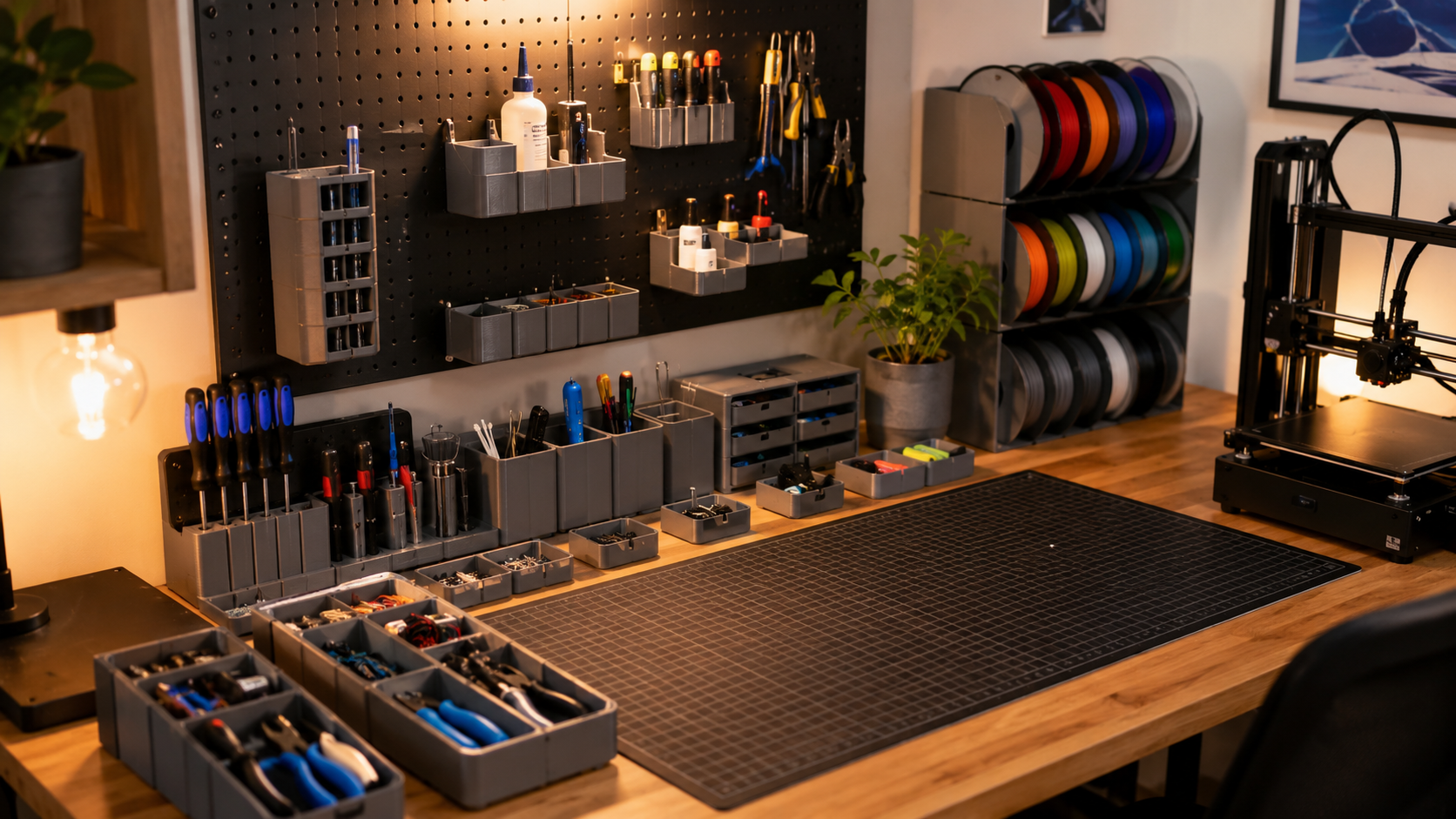

Quick Summary
- Gridfinity is an open-source modular storage standard created by Zack Freedman in 2022, using 42mm interlocking base plates and customizable bins for desktop and drawer organization.
- Over 90% of popular Gridfinity models on DIY3D are designed for 0.2mm layer height with 15% gyroid infill, using PLA for office use or PETG for workshop environments.
- The Click-Lock Stackable Lid for Gridfinity (792 downloads, 88 likes) and the Rugged Cable Organizer (736 downloads, 92 likes) are the two most popular Gridfinity models on DIY3D.
- DIY3D offers a growing collection of free Gridfinity models spanning tool holders, cable management, battery storage, and modular drawer systems, all available as STL and 3MF downloads.
Gridfinity 3D print models are a standardized, open-source modular storage system you can print at home using interlocking base plates and customizable bins. This roundup covers the 10 best free Gridfinity STL and 3MF files available on DIY3D, with print settings and assembly tips for each model.
Contents
Essential Gridfinity Base Components
Every Gridfinity setup starts with base plates and versatile bin options. The community has moved beyond simple open bins toward more sophisticated base components that save filament and add functionality.
Gridfinity Collection Solid Bins for Customization (STEP Files)
This collection gives you a solid foundation for any Gridfinity layout. The models range from 1×1 up to 5×5 grid units across 9 different heights, so you can mix and match sizes without committing to a specific use case upfront. The included STEP files let you modify the base geometry in any CAD tool for custom cutouts, dividers, or labeling tabs.
Print settings: 0.2mm layer height, 15% gyroid infill, no supports needed. Stick to PLA for office desk use or PETG if the bins go in a garage workshop where temperatures climb. The 3MF files embed a Bambu Lab A1 profile, but the STL exports work in any slicer.
Download: Gridfinity Collection Solid Bins on DIY3D (free STL, STEP, and 3MF files). No paywall, no account required.
Click-Lock Stackable Lid for Gridfinity
This lid snaps onto any Gridfinity-compatible box with the standard lip profile, turning open bins into stackable, dust-protected storage. The click-lock mechanism uses a small interference fit, no magnets or hardware required. At 792 downloads and 88 likes, this is the most-downloaded Gridfinity accessory on DIY3D across all categories.
Print settings: 0.2mm layer height, 20% infill, PLA works fine. Print one test lid first to verify the snap fit on your specific bin. If the lid is too tight, scale it 0.5% larger in your slicer. No supports, no brim.
Download: Click-Lock Stackable Lid for Gridfinity on DIY3D (free STL and 3MF files).
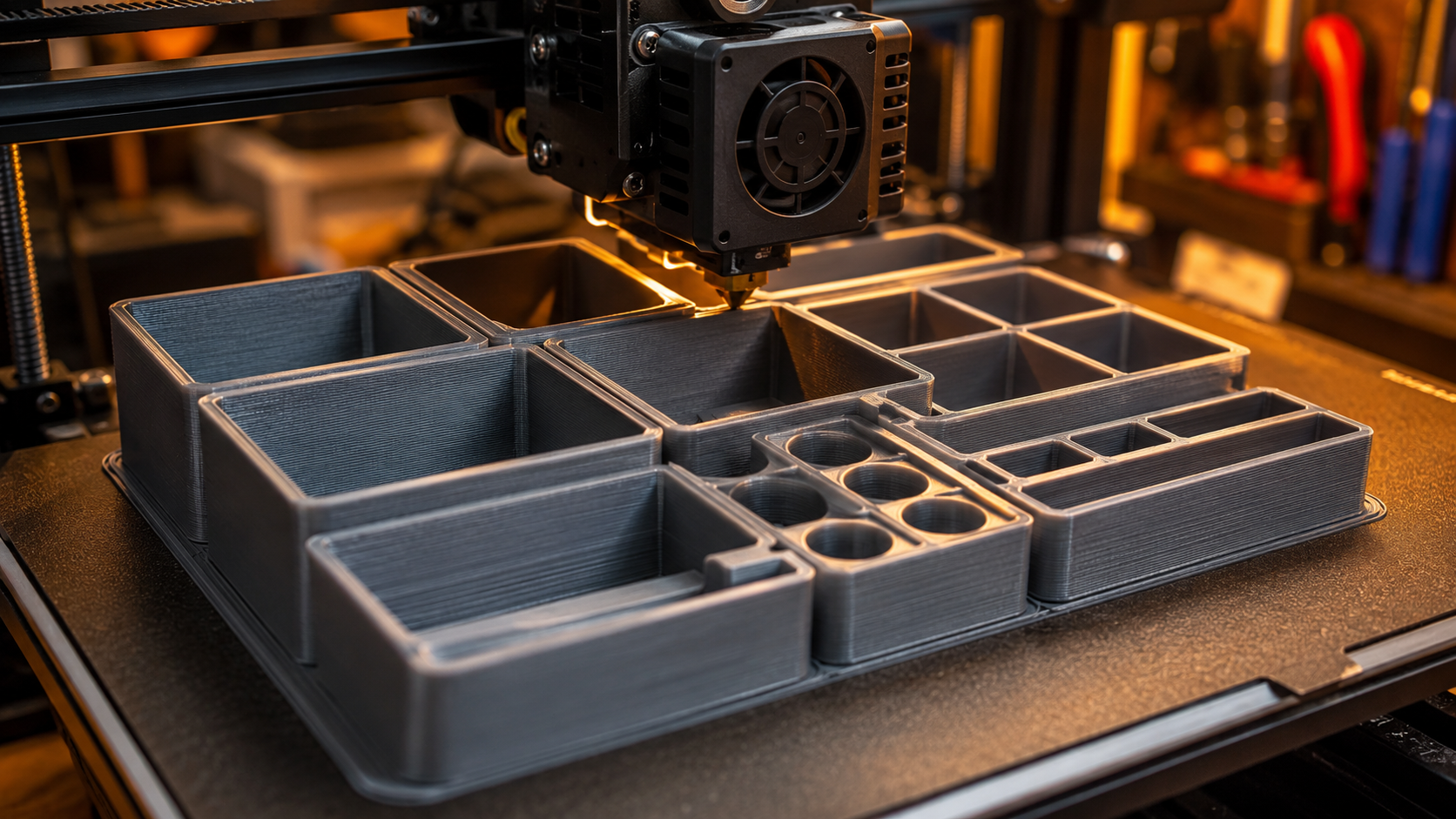
Tool and Workshop Organizers
Tool-specific Gridfinity bins are where the system really earns its keep. Instead of rummaging through a drawer for the right bit or battery, each tool type gets a dedicated home that clips right into your base plate grid.
Gridfinity Dremel Bit Holder
A 4×1 Gridfinity bin with precision holes for 3mm Dremel bits. The angled bit bed makes each bit visible at a glance, and the footprint fits neatly in a shallow drawer alongside other tool bins. 504 downloads and 72 likes confirm this is a staple for any maker who uses rotary tools.
Print settings: 0.16mm layer height for cleaner hole detail, 15% infill, PLA. Enable ironing on the top surface for a smooth finish. No supports, but watch the first layer around the bit holes, brim recommended for textured PEI plates.
Download: Gridfinity Dremel Bit Holder on DIY3D (free STL and 3MF files).
Gridfinity USB Wall Chargers Bin
A 3×1 bin sized for North American USB wall chargers, 4 units tall to accommodate bulky charging bricks. The underside has recesses for 6x2mm press-fit magnets if you want magnetic locking in your Gridfinity base plate. The holes are modeled with improved circular detail so they come out round on standard 0.4mm nozzles.
Print settings: 0.2mm layer height, 15% infill, PLA. Pause at the layer just before the magnet holes close to insert 6x2mm magnets if using. No supports needed. Print with a brim for bed adhesion on tall bins.
Download: Gridfinity USB Wall Chargers Bin on DIY3D (free STL and 3MF files).
Gridfinity 9V Battery Trays (Multiple Sizes)
Battery organization is one of the most common Gridfinity use cases. These trays come in multiple Gridfinity footprint sizes and hold 9V batteries with a snug friction fit. The design includes hole detail improvements for cleaner prints on 0.4mm nozzles, and the compact footprint means you can line several trays in a single drawer.
Print settings: 0.2mm layer height, 15% infill, PLA. Print one test tray first to confirm your battery fitment is snug but removable. Scale 0.5% if needed. No supports, no brim for trays under 4 units tall.
Download: Gridfinity 9V Battery Trays on DIY3D (free STL and 3MF files).
Cable and Media Storage Solutions
Loose cables and tiny SD cards disappear fast in a junk drawer. These Gridfinity organizers turn chaos into labeled compartments that stay put in your base plate.
Rugged Cable Organizer – Gridfinity
This rugged Gridfinity-compatible magazine-style holder accommodates USB cables, charging cables, and audio cables with individual compartments. At 736 downloads and 92 likes, it is the Gridfinity model with the highest like count on DIY3D. The rugged design language means thicker walls and reinforced corners, so it holds up in a workshop drawer that gets opened and closed frequently.
Print settings: 0.2mm layer height, 20% infill for wall strength, PETG recommended for workshop use. No supports. Consider printing with a 0.6mm nozzle for even tougher walls.
Download: Rugged Cable Organizer on DIY3D (free STL and 3MF files).
Gridfinity SD Card MicroSD Card and USB Stick Holder
This one bin handles three media formats: 10 MicroSD cards, 6 standard SD cards, and 6 USB-A memory sticks. The slot spacing leaves enough room to grab each card without disturbing its neighbors. 477 downloads and 53 likes make it one of the most downloaded storage accessories on DIY3D.
Print settings: 0.2mm layer height, 15% infill, PLA. Use a 0.4mm nozzle for sharp slot details. Test with one SD card and one USB stick before printing duplicates. No supports, no brim.
Download: Gridfinity SD Card MicroSD Card and USB Stick Holder on DIY3D (free STL and 3MF files).
Modular Storage Systems
For makers who need more than open bins, these expanded Gridfinity-compatible systems add drawers, racks, and under-desk mounting to the standard grid.
Modular Rack System for Gridfinity
A fully customizable modular rack system for Gridfinity drawers. The rack extends horizontally and vertically, with individual drawer modules that slide in and out. 384 downloads and 48 likes. The STL set includes all the connector brackets and drawer bodies so you can build a rack that fits your exact drawer dimensions rather than forcing a standard layout.
Print settings: 0.2mm layer height, 20% infill, PLA or PETG. The sliding drawer parts benefit from ironing on contact surfaces for smoother action. No supports for most components.
Download: Modular Rack System for Gridfinity on DIY3D (free STL and 3MF files).
Gridfinity Modular Drawer System
Sometimes you need enclosed drawers rather than open bins. This system places a full Gridfinity grid inside a drawer frame, combining the organization of Gridfinity with the dust protection of closed drawers. The middle row includes corrected measurements based on community feedback, and the drawers use standard Gridfinity base plates on the interior floor.
Print settings: 0.2mm layer height, 20% infill, PETG recommended for structural parts. The drawer slides may need light sanding for smooth operation. Assembly uses M3 screws, no glue.
Download: Gridfinity Modular Drawer System on DIY3D (free STL and 3MF files).
Under Desk Drawer Modular
This under-desk drawer system mounts directly below your work surface and supports a full 4×3 Gridfinity layout on the drawer floor. It uses a push-push latching mechanism to open and close, so no drawer pull hardware is needed. 100 downloads. The design recovers otherwise wasted desk underside space for Gridfinity-organized tool storage.
Print settings: 0.2mm layer height, 25% infill for the latch mechanism, PETG for the drawer body. The push-push mechanism requires precise assembly, test fit the latch components before final printing. Supports needed for the latch housing overhangs.
Download: Under Desk Drawer Modular on DIY3D (free STL and 3MF files).
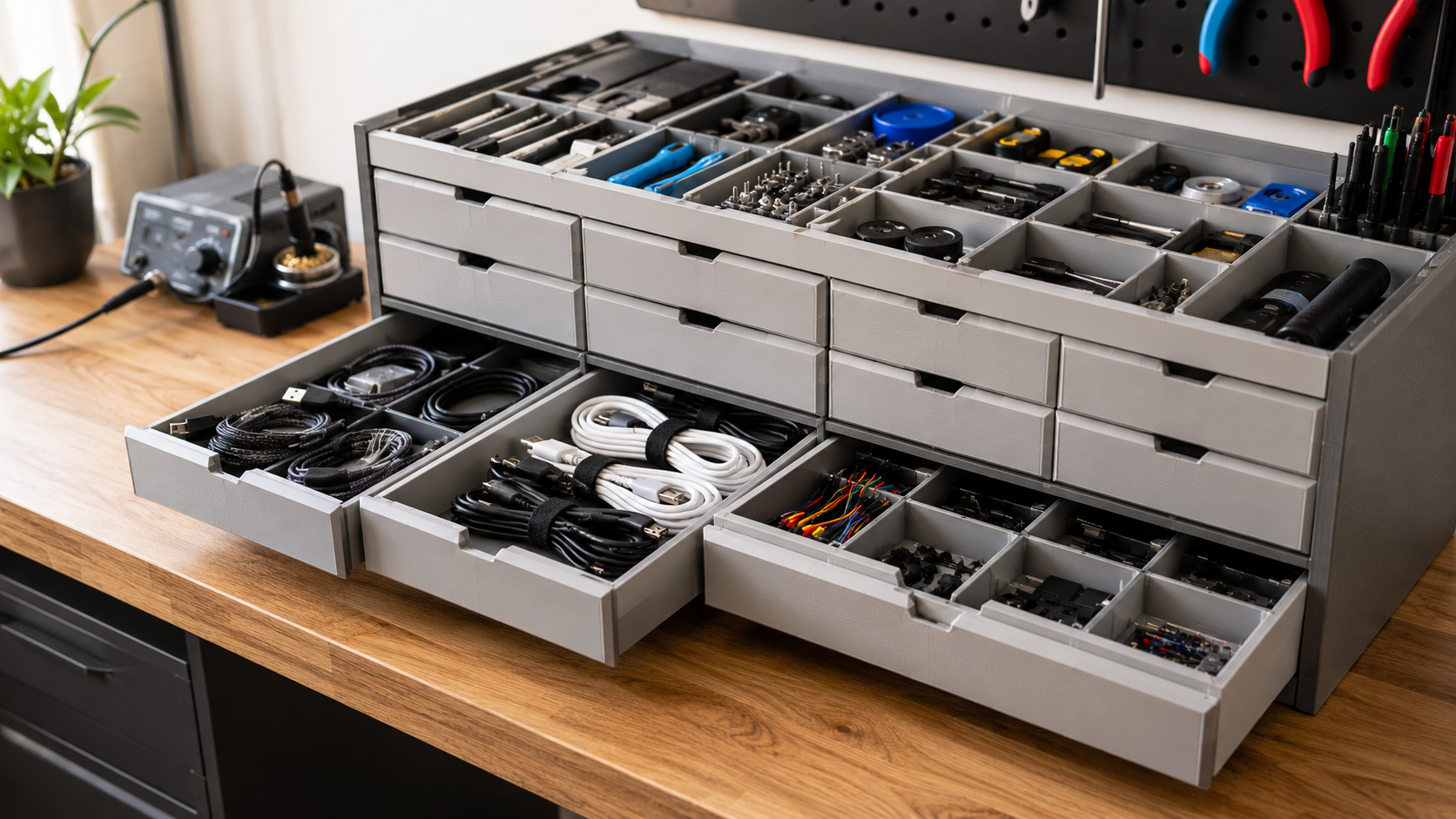
Print Settings for Gridfinity Models
Most Gridfinity models share common print parameters regardless of their specific function. These baseline settings will get you clean results on any calibrated FDM printer.
📊 Gridfinity by the Numbers
The Gridfinity ecosystem now includes thousands of community-designed modules across Printables, MakerWorld, Thingiverse, and DIY3D. Zack Freedman released the original specification in 2022 under the MIT license, and the system has since become what the Snapmaker blog calls “the undisputed standard for horizontal organization” in the 3D printing community. A single 2×4 base plate uses 80 to 120 grams of filament, and a fully populated desk drawer can consume 350 to 500 grams before adding any bins. Low-profile base plates (4.75mm vs. the standard 7mm) are now available for shallow drawers, reducing filament use by roughly 30%.
Baseline print parameters:
- Layer height: 0.2mm for most bins. Use 0.16mm or 0.12mm for bins with fine text or small holes.
- Infill: 15% gyroid or honeycomb for bins. 20% for structural parts like drawer bodies and latches.
- Filament: PLA for desk and office use (bed temperature 60℃). PETG for garage, workshop, or any environment above 50℃ ambient.
- Supports: Most Gridfinity bins print support-free. The exceptions are latch housings and overhanging features in drawer systems.
- Bed adhesion: Brim recommended for bins taller than 4 grid units. A brim also helps prevent warping on larger base plates.
- Nozzle: 0.4mm standard. A 0.6mm nozzle works well for reinforced utility bins and reduces print time by roughly 30%.
- Magnet holes: Pause at layer height before holes close to insert 6x2mm or 6x3mm neodymium magnets. Apply a drop of CA glue for permanent retention.
Calibration tip: Always print a single test bin before committing to a full drawer. Gridfinity tolerances are designed for a 0.2mm clearance between bins and base plates, but every printer handles corners and elephant foot differently. One test print saves you a 12-hour reprint.
Ready to Print Your Setup?
All 10 models from this roundup are ready to download on DIY3D in STL and 3MF formats, no account required.
Download Free Gridfinity Models
Free to download. No paywalls. Community-uploaded designs.
Featured Gridfinity Models on DIY3D
All 10 models in this roundup are available as free downloads on DIY3D. Click any model to jump to its section above for details, print settings, and download links.
- Gridfinity Collection Solid Bins for Customization (STEP Files)
- Click-Lock Stackable Lid for Gridfinity
- Gridfinity Dremel Bit Holder
- Gridfinity USB Wall Chargers Bin
- Gridfinity 9V Battery Trays (Multiple Sizes)
- Rugged Cable Organizer – Gridfinity
- Gridfinity SD Card MicroSD Card and USB Stick Holder
- Modular Rack System for Gridfinity
- Gridfinity Modular Drawer System
- Under Desk Drawer Modular
Browse more free models and find your next print-ready file on DIY3D.
Common Questions About Gridfinity 3D Prints
What is the Gridfinity system for 3D printing?
The Gridfinity system is an open-source modular storage standard that uses a 42x42mm grid of interlocking base plates and customizable bins. It was created by Zack Freedman in 2022 and has become the most widely used 3D printed organization system for drawers and desktops. The MIT license means anyone can remix, modify, or sell Gridfinity designs without restrictions.
What filament is best for printing Gridfinity bins?
PLA is the best choice for Gridfinity bins in desk and office environments because it prints easily and holds dimensional accuracy well. PETG is preferred for workshop or garage use where temperatures exceed 50℃ because it resists softening and creep. ASA is a suitable option for automotive or outdoor use but requires an enclosure for consistent results.
Do you need magnets for Gridfinity base plates?
No, magnets are entirely optional. Standard Gridfinity base plates use a friction fit to hold bins in place, which works fine for stationary drawers. Magnets add retention for portable toolboxes or vertically mounted setups. Models like the Click-Lock Stackable Lid use mechanical snap fits instead, eliminating the need for magnets altogether.
Can you print Gridfinity on any FDM printer?
Yes, Gridfinity models print on any calibrated FDM printer with a build plate at least 150x150mm. The standard 0.4mm nozzle handles the 42mm grid and bin walls easily. Larger base plates may need a brim for bed adhesion, and printers without enclosures should use PLA for best results. Resin printers are not recommended for Gridfinity components due to brittleness and dimensional shrinkage.
How much filament does a full Gridfinity drawer use?
A typical 2×4 Gridfinity base plate uses 80 to 120 grams of filament. Filling a standard desk drawer with a base plate and mixed bins typically requires 350 to 500 grams total. Low-profile base plates (4.75mm tall) reduce filament use by about 30% compared to the original 7mm specification and are recommended for shallow drawers.
Start Organizing With Free Gridfinity 3D Print Models
The 10 models in this roundup cover the full range of what Gridfinity 3D print designs can do: from quick-print tool holders and battery trays to full modular drawer systems and under-desk storage. Every model is available as a free download on DIY3D, with STL files for slicer-agnostic printing and 3MF files with embedded Bambu Lab profiles for one-click slicing.
Start with the Solid Bins for Customization as your base, then add the specialized holders as you identify the gaps in your workspace. One test bin per type is all it takes to dial in your printer’s tolerance, and the 0.2mm clearance standard means most models will fit together without post-processing.
Gridfinity’s strength is that it grows with your needs. A single base plate with three bins today can expand into a full drawer system next month, and every new module clicks into the same 42mm grid without requiring a redesign.
Find Your Next Gridfinity Print
Download free STL and 3MF files from DIY3D’s growing library of community-uploaded Gridfinity models.
No account required. No paywalls. Just print-ready files.
External citation: Gridfinity described as “the undisputed standard for horizontal organization” in the 3D printing community. Source: Snapmaker Blog – 3D Printed Organization: Gridfinity, Multiboard, HSW, OpenGrid, and Skadis (2025).
